

If you have known us for a while, you know that everything we do is with purpose and intent. Consistently engaging our students with academic content in real, hands-on ways is no exception.
This month, Mrs. Donnelly is highlighting details about the benefits of hands-on math for young learners, specifically the range of kindergarten to 3rd grade. She will show us how there is purpose in playing.
1. Students genuinely look forward to math!
Our students can’t wait for math time every day. They receive plenty of academic rigor and work diligently throughout our entire math block. The secret? They often think they’re playing games, solving puzzles, and having fun! By making math engaging and interactive, students are excited to dive into challenging problems without feeling intimidated by the work ahead of them.
2. Hands-on learning makes math engaging.
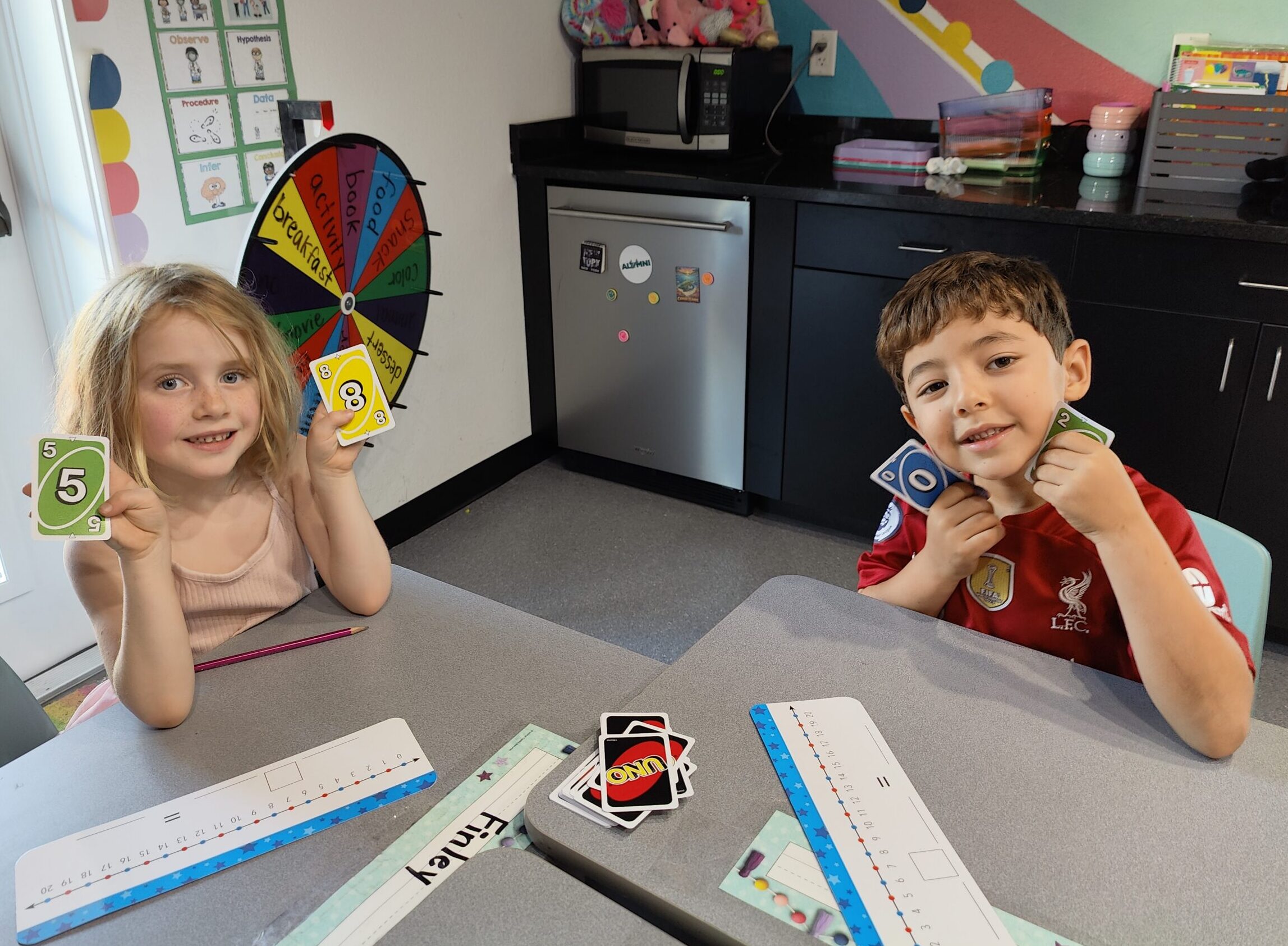
Rather than practicing addition and subtraction skills with a worksheet full of problems, students use dice and UNO cards to generate numbers, then take turns being the teacher and explaining their problem-solving strategies to their classmates.
They’re not just finding answers; they’re learning to communicate their thinking, listen to others, and approach problems in different ways.
We turn math practice into an opportunity to collaborate, think critically, and learn from one another. Students are actively involved in their learning rather than simply completing a task.
3. We turn math into an adventure.
Instead of relying on rote memorization to practice multiplication, students become math detectives, searching the classroom for cleverly hidden factors. Learning becomes an active challenge that sparks curiosity, encourages collaboration, and gives students a reason to put their skills to work.
When students are on a mission to solve a mystery, practice feels less like repetition and more like an adventure. They’re motivated to keep going, and they’re building important mathematical skills along the way.
4. We want students to understand the why behind the math.
Math can develop an intimidating reputation, and children sometimes begin to believe they’re “bad at math” before they’ve had the opportunity to discover what they’re capable of. We want to change that narrative early.
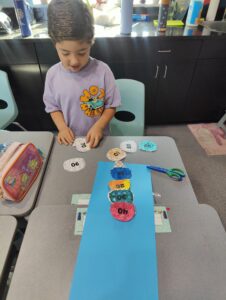
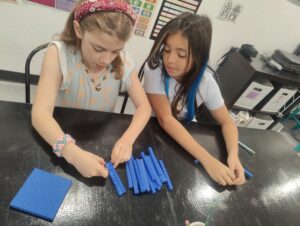
By using manipulatives and physically building, moving, and rearranging objects to represent addition and subtraction, students can see what the numbers and equations actually mean. They begin to understand why a strategy works instead of simply memorizing a procedure to follow.
These concrete experiences help students build a strong mathematical foundation, giving them the confidence to tackle increasingly complex problems as they grow.
5. Project-based learning brings math to life beyond the classroom.
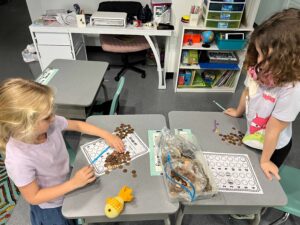
We look for authentic, hands-on opportunities for students to apply their mathematical skills to real-world situations. When students plan a lemonade stand or cookie sale, they have to think through the math behind the business: setting prices, counting money, making change, and figuring out how much they’ve earned.
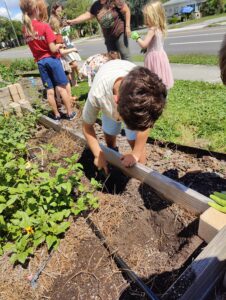
When we plant native plants, students measure and record their growth over time. As we observe caterpillars, we measure their daily growth and use our data to notice patterns and changes. Even a trip to the park can become a math lesson! Using yardsticks to measure the depth of the ocean’s sunlight zone helps students visualize just how deep that zone really is, connecting an abstract science concept to a tangible measurement.
These experiences show students that math isn’t just something we learn at school; it’s a tool we use to understand the world, solve real problems, and make meaningful decisions. When children see a purpose for the math they’re learning, the skills become more relevant, memorable, and exciting.
6. We cultivate curiosity instead of dread.
 Our goal is for students to approach math with confidence and excitement. We want them eager to dive into a challenge, solve a number mystery, test an idea, and discover a solution, not groaning at the thought of another worksheet.
Mistakes are part of the process, and explaining, experimenting, and trying again are all valuable parts of learning. We encourage students to take risks, explore different strategies, and recognize that there is often more than one way to solve a problem.
When students feel safe to make mistakes and are encouraged to persevere, they begin to see themselves as capable mathematical thinkers.
7. Rigor doesn’t have to mean sitting still.
Academic excellence doesn’t always look like students sitting quietly at desks, independently completing pages of work. It can look like children moving around the classroom, manipulating objects, talking through their reasoning, collaborating with classmates, and enthusiastically tackling challenging problems.
A classroom can be lively, a little messy, and full of movement while still being a place of deep, meaningful learning. In fact, these active experiences often give students more opportunities to explain their thinking, defend their reasoning, consider different perspectives, and develop a deeper understanding of the material.
Fun and rigor aren’t opposites. When thoughtfully designed, engaging activities can challenge students academically while helping them develop a genuine love of learning.
8. Our ultimate goal is to build confident mathematical thinkers.
We want our youngest learners to develop strong foundational skills, understand mathematical concepts, persevere through challenges, and recognize that they are capable problem-solvers. We’re not just teaching students how to calculate; we’re helping them learn how to think critically, approach challenges creatively, and trust themselves to work through a difficult problem.
When children experience math as something they can explore, understand, and enjoy, we help them build not only mathematical knowledge but also a positive relationship with learning that can last a lifetime.
Closing thought
Math can be rigorous and joyful. It can be challenging and playful. And it can be so much more than numbers on a page.
When we give children the tools, freedom, and confidence to explore mathematical ideas, we’re not just teaching them how to solve problems. We’re helping them discover that they are problem-solvers. Sometimes, the most meaningful learning happens when students are having so much fun that they don’t even realize just how hard their brains are working!