

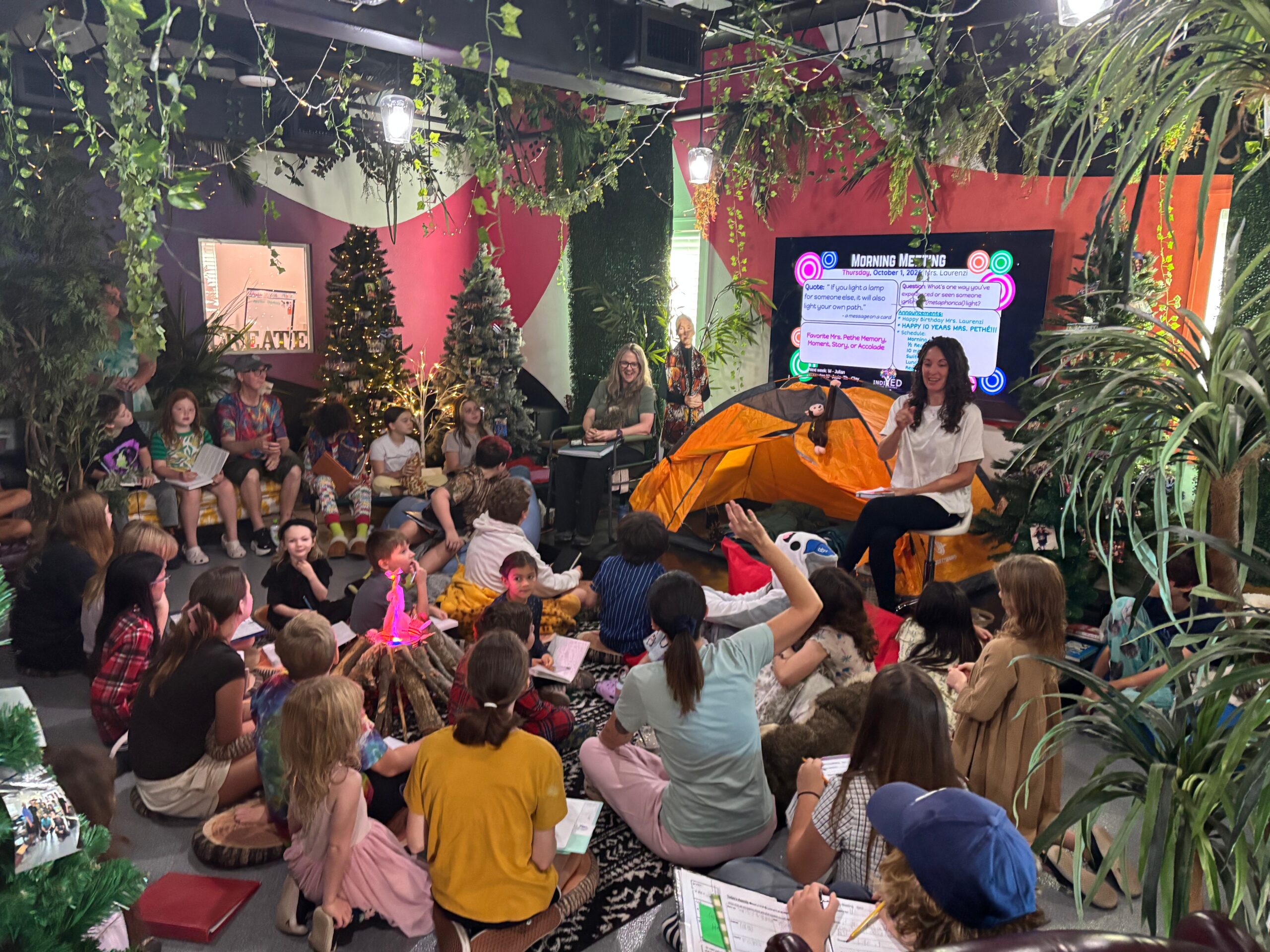
This month we celebrated big.
We (and by we I mean our families, teachers, staff, and students) all pulled off a huge surprise.
You see, this year is Mrs. Pethe’s 10th year with us and we wanted to have a surprise celebration for her. By transforming our school into a forest and Jane Goodall-inspired Gombe Reserve research tent, we did just that.
Words can’t fully describe how much Mrs. Pethe’ means to all of us. But we did our best to try! Everyone took turns sharing their favorite memories, qualities, and accomplishments of Mrs. Pethe’. There were almost as many instances of her jump-scaring us as there were of her inspiring us and guiding us to learn. Seeing our teachers, parents, students, and even alumni share thoughtful words with her really made us realize something.
This amazing celebration was a beautiful representation of the core of who we are.
At Indi-ED, Relationships Are the Foundation of 21st Century Success
When people talk about 21st-century education, they often focus on skills like critical thinking, communication, collaboration, creativity, and adaptability. And while these are absolutely essential in today’s world, at Indi-ED, we believe something even more fundamental must come first: relationships.
Reimagining education isn’t just about what students learn—it’s about how they learn, and more importantly, who they’re becoming in the process. That’s why, in addition to integrating 21st-century skills into every aspect of our curriculum, we intentionally focus on building strong, authentic relationships with and among our students.
Why Relationships Come First
You can’t expect students to take risks, challenge assumptions, or engage in deep thinking if they don’t feel seen, heard, and supported. Trust is the currency of growth. Before we dive into project-based learning, Socratic discussions, or real-world problem solving, we make sure each student knows they belong.
Strong relationships create a safe environment where students are not only more willing to share their ideas and perspectives—they’re eager to listen to others, too. And that’s the foundation of meaningful collaboration and constructive dialogue.
Skills That Go Beyond the Classroom
We’re not just preparing students for the next test or the next grade level. We’re preparing them for life—at home, in their communities, and in the ever-evolving global landscape.
That’s why our students don’t just learn how to think critically, but how to communicate those thoughts effectively. We model and teach how to have respectful, engaging, intellectual conversations—skills that are just as vital at a family dinner table as they are in a boardroom.
Opportunities For Developing These Skills
Each and every one of our students develop emotional intelligence, empathy, and the ability to navigate complex conversations with both confidence and curiosity. That is because we consciously incorporate multiple opportunities each day for our students to develop these critical skills.
- Through daily experiences with local experts such as business owners, scientists, CEOs, engineers, etc.
- Intentional discussions, which we start and end each day with and they are student led.
- Opportunities to think critically and exchange ideas. For example, Socratic discussions and daily during classroom discussions where questions are encouraged.
- Relationship-driven learning through partnerships, collaborative projects, and encouraging our students to teach and support each other.
- Milestone celebrations or special events, where students take time to explicitly reflect on deeper meanings and relationships.
The Real-World Impact
By weaving relationship-building into everything we do, we’re creating learners who are not only academically equipped for high school, college, and a career of their choice, but they’re prepared for life. They can collaborate with a team, advocate for their ideas, and resolve conflicts constructively. They can speak with adults and peers alike with clarity and confidence. They can engage in intellectual discourse and bring a thoughtful perspective to any table they sit at.
When students actively observe and take part in meaningful relationships with their peers and the supportive adults in their life, it builds trust and self-efficacy.
At Indi-ED, we’re not just teaching students how to succeed in the future. We’re helping them build the relationships and skills they need to thrive in the present—both in and out of the classroom.