

Imagine walking into your school on the first day. No textbooks, no worksheets… Just a fresh open mind, a pencil, and a journal.
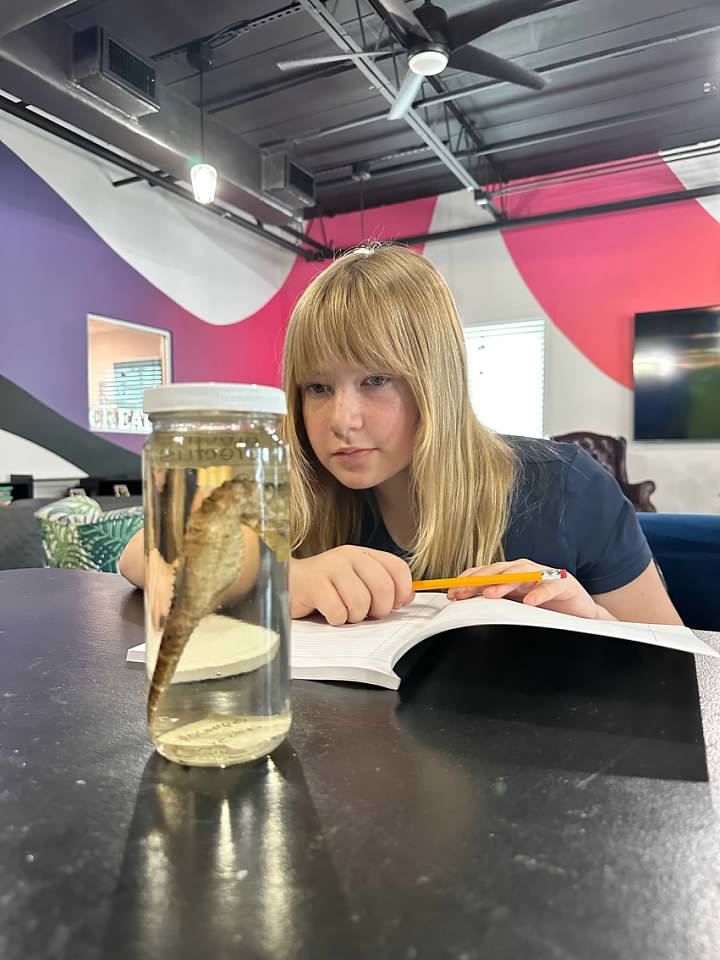
The first thing you see is a massive, pointy, colorful head of coral bigger than your cat that you left at home curled up in your bed. The arms are reaching up and out, pointing in all different directions as if inviting you to go look at what appears to be close to 100 different jars full of liquid with mysterious objects floating inside of them. All of this against the backdrop of a silky, shiny material the color of the ocean.
There is even a long triangular object hanging from the ceiling with a jar attached to the bottom.
“Mrs. Pethe’, what is that?!” “Why is there a large blob with arms floating in that jar?” “Is that a shark or a stingray?” “Why does that long slimy creature have so many sharp teeth?”
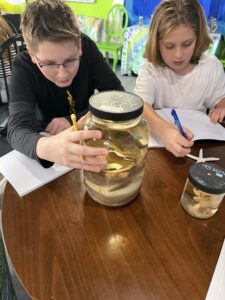
Your teacher responded with her trademark smile welcoming you to your first day of school and you just know she is going to tell you all of the answers to my questions…but her response is not the typical response you may have expected to get in a classroom. She said, “I am so glad you are asking so many questions, and I can’t wait to hear about the answers that you discover!”
The Wonder Museum did exactly what it was supposed to.
It sparked an incredible amount of curiosity among all of the students and their parents as they dropped them off for their first day of school. Children naturally ask a lot of questions, they are curious and full of wonder.
The best way to nurture their desire to inquire is to help them learn how to find the answers to their questions, to discover that science doesn’t always have the answers, and that if you search for your own answers, you will start to think of even more questions.
Our Wonder Museum was made possible by a wide range of scientists in our community from fellow science teachers, FWC, Tampa Bay Watch, and NOAA. Not only were they kind enough to collectively lend us this massive collection of marine specimens, but they are also offering to come speak to our kids and answer some of their questions throughout the school year.
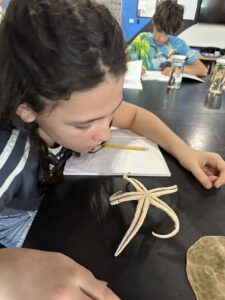
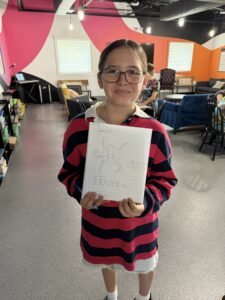
By the end of our first week of school, students had sketched some of the specimens they were most curious about, recorded facts they knew, and wrote down questions that they had in their Discovery Journals.
Then we brought all three cohorts together, children that range from kindergarten to 8th grade, to learn about the role that problem-solving and collaboration play in the real world, and most importantly, to practice these skills together. They were put into groups of four and given the challenge to use the recycled items they brought in to design a way to explore the 99% of the deep ocean that remains undiscovered.
This challenge wasn’t about building the best device to dive deep into the depths of the ocean to find the answers to all of our questions. It was about the experience of collaborating like a scientist. What happens when you run into obstacles, encounter ideas that are different than your own, and work through how to come up with solutions. Or even how to figure out what to do when there isn’t a solution.
This was as much about failed plans, compromise, moving forward, and experiencing how challenging communication can be when working with a group, as it was about continuing to nurture their curiosity.
At the end of this activity, the kids shared what went well and what they would change about the experience. A few examples of what was shared included, “My team did a great job at listening to all of our ideas.” “Our team ran out of time and had to quickly put together our plan in the last 4 minutes.” “Some of the people on my team had different ideas and it was hard to let go of an idea that you came up with so that we could go with the majority vote.”
These weren’t just reflections from the older kids. Even our students as young as kindergarten and first grade are able to reflect in this way. The best part is that these are skills we will work on throughout the entire school year, continuing to reflect and grow while doing so.
It started with a question, and this is just the beginning.
We will continue to nurture their curiosity and empower each child to search for answers and work together to explore not only the specimens in our Wonder Museum, but also at a variety of experiences we have planned for them this year.
From scientists visiting our students, our students touring the FWC Collections Lab, having a sleepover at the Florida Aquarium, and a sleepover camp at Sea Camp in the Florida Keys just to name a few. This is just one snapshot of what experiential learning looks like at Indi-ED. We don’t only teach the standard subjects. We don’t only learn about 21st century skills like problem-solving and collaboration.
We jump in feet first with a big, refreshing splash into a world full of sparkle and wonder, in a way that makes us incredibly enthusiastic about exploring what we don’t yet understand.